
I’ve been reading Degenesis for a while now, and I ran it at the table a couple of times.
I ran twice the quickstart community scenario "Provider" and, after months of dreaming about it, I finally ran the magnificent "In Thy Blood" scenario in one long 7-hour session.
So, this isn’t a quick reaction or a first-impression post. It comes from spending time with the books, letting the setting sink in, and then trying to make it actually work in play.
Let me start with what Degenesis does remarkably well.
Degenesis is often lumped together with Mad Max and post-apocalyptic settings in general. I think that comparison is unfair. I’ve never felt much attraction to post-apocalypse as a genre, largely because it tends to fixate on a single idea: the exposure of human brutality once social rules collapse. Civilization falls, masks come off, and humanity supposedly reverts to barbarism. It’s a thin view of human nature, one that overemphasizes violence and predation while neglecting something far more fundamental.
We are social animals. We need meaning. And meaning is not something we generate alone—it is something that only exists within a community.

Degenesis understands this at a deep level. This is not a post-apocalypse about people merely surviving, scavenging, or dominating one another. It is a world in which people reorganize themselves around meaning. Cultures and cults emerge not as gimmicks or color, but as existential responses to catastrophe. Science, law and order, religion, information, preservation, hedonism, each "Cult" in the game embodies one such view, and these are not just ideological banners, they are answers to the question of what still makes human life meaningful after the end of the world.
These groups do not exist in a vacuum. They cooperate, clash, align temporarily, and fracture again, in a fine tapestry of political and sociological interactions, all while facing the looming threat of an extra-terrestrial infestation that is genuinely alien, and which attacks the very notion of human identity in the same way as Lovecraft's Color Out of Space. The infection spreads, bringing with it monsters that were once human. Are these funghi-infested, hivemind creatures with powerful psionic powers to be the replacement of humanity?
Humanity in Degenesis does not merely endure chaos; it actively resists it by constructing shared systems of meaning. That alone places the game far beyond most post-apocalyptic settings.
/f/72501/3840x1646/48297b15b8/stories-the-cleft.jpg)
The worldbuilding reinforces this constantly. The level of detail is high, but it rarely feels indulgent. Geography, history, and politics all matter, and they interlock in ways that make the setting feel as though it existed long before the players arrived and will continue long after they leave. This is not a backdrop waiting to be activated; it is a world that feels alive.
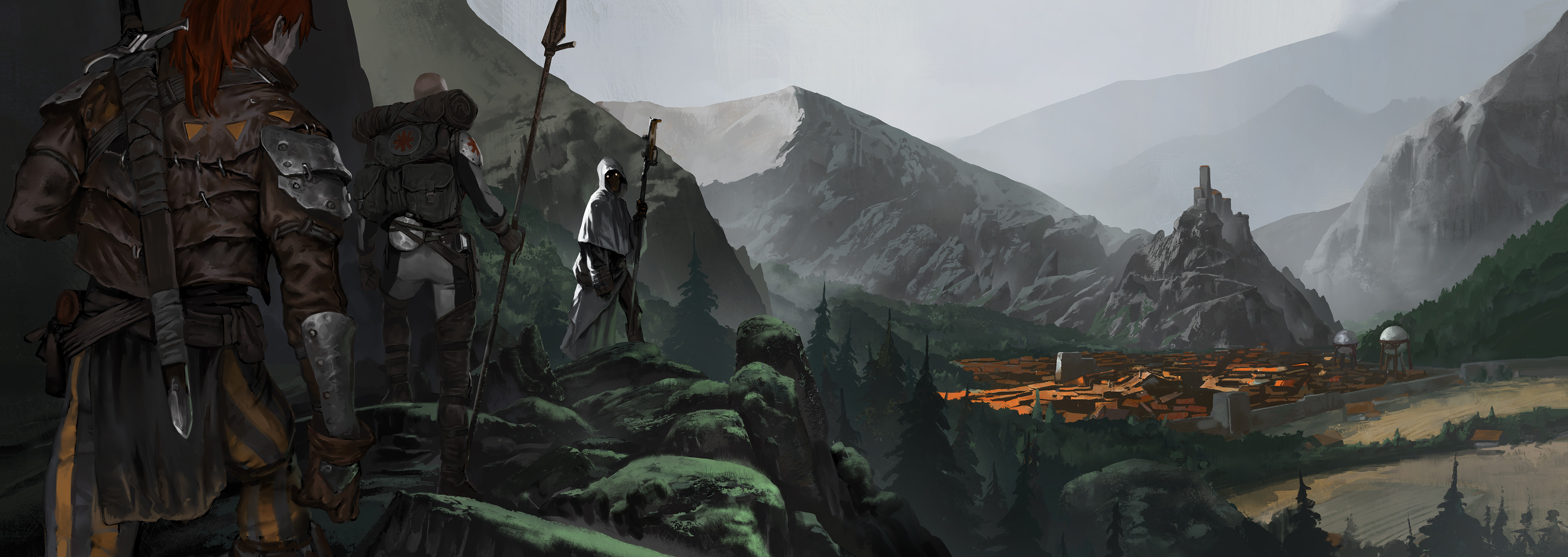
The art deserves separate mention. The books are, quite simply, beautiful objects. The artwork does not decorate the text, it embodies it. It gives the setting weight, texture, and emotional tone. You don’t just read Degenesis; you absorb it visually. It is some of the most inspiring art ever produced for a role-playing game, and it does an enormous amount of heavy lifting in making the world feel real.
How many RPGs do you know that even come with trailers with live actors?
https://www.youtube.com/watch?v=WTCARC91yyw
https://www.youtube.com/watch?v=0Tw3KaMr8wk
So where does it falter?
For me, the biggest issue with Degenesis is combat. On paper, the combat system is not especially complex. In fact, it is a very traditional, simple, simulationist system, akin to Chronicles of Darkness. In practice, it becomes so through accumulation. Character Potentials (these are powers characters derive from their Cult), weapon-specific rules, exceptions, and interactions stack up, and the result is friction. Each individual rule is defensible, but together they slow the game down dramatically.
My experience running Degenesis was consistent: whenever combat started, the pace dropped sharply. Sometimes it felt as though the game almost stalled. That is a serious problem in a setting like this, where violence is supposed to feel sudden, overwhelming, and terrifying. Instead, combat often turns into a careful, procedural exercise in rule management.
The other major weakness lies in the published scenarios. As mentioned, I ran "In Thy Blood" and, at its core, it is excellent. The premise weaves together politics, personal tragedy, belief, and cosmic horror in a way that feels perfectly attuned to the setting. The raw material is very strong.
The problem is how that material is presented. As written, the scenario is an extremely rigid railroad. If run straight from the text, player agency collapses and events unfold because the script demands it, not because of meaningful choices. That rigidity is not a minor flaw; it actively undermines the thematic strengths of the game.
(My practical advice for "In Thy Blood": take Carmino Ferro, place him outside of the city walls, forbidden to enter Luccatore, instead of walking around freely. Make him a quest-giver that can advise the players but not hang around wiht them. This will force more agency on the players, while allowing guidance to be available when needed.)
Running Degenesis well, at least with this scenario, requires the gamemaster to push back against the text. You have to extract the core ideas, loosen the structure, reorder events, and sometimes ignore the written progression entirely. The scenario contains a pearl, but it is embedded in a shell. The work of restructuring it can be rewarding, but it is also a burden that should not be necessary to this extent.
So where does that leave Degenesis?
It is one of the most ambitious and philosophically interesting role-playing games I’ve encountered. It treats humanity not as savages waiting to be unleashed, but as meaning-making beings under extreme existential pressure. Its world-building is dense without being sterile, political without being simplistic, and elevated enormously by extraordinary art.
At the same time, it demands effort, and it is frustrating, because a considerable part of the GM's effort effort comes from self-inflicted pains: the details that make a simple system hard, the presentation of scenarios that makes brilliant ideas into pure railroads.
If you do the necessary work, Degenesis can be exceptional. If you don’t, it risks suffocating under the weight of its own machinery.
Frankly, I think the effort is well worth it.
And, in a strange way, that may be fitting. A game about humanity struggling to impose meaning on chaos perhaps cannot help but demand some struggle of its own.
The game has been out-of-print for some time, but all the pdfs of all the books, and there are many, are available for free at https://degenesis.com/.
Also, if you are really in for a quickstart game of Degenesis, you may try to contact me, I am likely to run sessions online for complete strangers out of love for a particular RPG...
Comments
Post a Comment